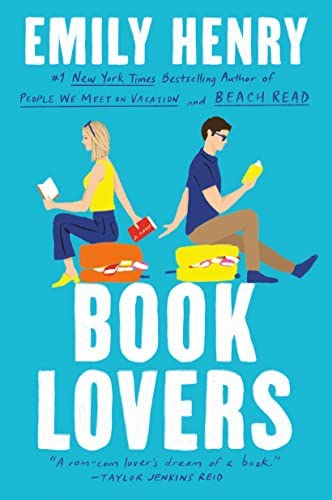
Book Lovers

by Emily Henry

Maybe love shouldn’t be built on a foundation of compromises, but maybe it can’t exist without them either. 

Book Lovers, by Emily Henry

Summary

Nora Stephens always sees herself as the person who gets left in the Hallmark Christmas movies. The ones where the city guy goes to east podunk to buy out a hotel, falls in love with the beautiful daughter of the owner, and decides to leave his fiancee and everything he knows behind in order to save the hotel and marry the small-town girl. Nora knows this to be true because it hasn’t just happened to her twice, but FOUR TIMES. But that’s OK because she is a phenomenal literary agent, and represents her clients extremely well.

So when her sister, Libby, drags Nora to Sunshine Falls which is the setting of a book by Libby’s favorite author (and Nora’s client), Nora finds herself in a situation she never dreamed she’d be in. Libby and Nora create a bucket list-type agreement on the airplane that they were going to do these crazy things like throw a party in the town and save a small business just like all of the Hallmark Movies.

But now, Nora is stuck in a town that’s nothing like the book described it to be, with the one person she does not want to be anywhere near, while her sister is obviously hiding something. Nora begins trying to complete these goals without losing her mind.

My Thoughts

Plot

I find myself liking these romantic comedy-type books more and more as I read them. Are they predictable? Absolutely. But are they entertaining? Also absolutely! I found Nora and Charlie’s characters very engaging. I liked the theme that played out throughout the book of things not always being like they seemed. I liked that Nora didn’t always know everything. I liked the tension between Nora and Charlie. I liked the banter throughout.

One thing that I don’t always see in this type of book, but did here, is true character growth and development. Nora starts as a fairly unlikable character due to the fact that she is so rigid in everything she does. But throughout, she grows as a character to see how this isn’t always the most healthy of behaviors. The same with Charlie-though his character development is more along the lines of him being willing to open himself up more.

Even though the plot was predictable, I still found myself completely engaged-wondering how the author was going to get from point a to point b. I liked that the story didn’t really go back and forth to New York, and all of Nora’s interaction outside of Sunshine Falls is through phone and e-mail. It really did remind me almost of a hallmark type movie.

Format

I read a physical copy of this book in just a few hours. I definitely think that was the right decision. I think that I would have gotten frustrated with the characters in an audiobook setting, because in books with a lot of witty banter, timing is everything. That being said, I really shouldn’t compare, since I have not looked into if an audiobook even exists.

Writing

This book is extremely witty, which I absolutely loved. I thought that the writing style was engaging and creative. The descriptions were done extremely well. Even the smuttier scenes didn’t feel super crazy, which I appreciated. I thought that even though it was written in the first person, each character still had a distinct voice that was recognizable throughout the story.

One thing that I’m not so sure about is that this story is billed as a rivals to lovers type, which is always fun. But I wouldn’t call this book a rivals to lovers book. Nora and Charlie had one interaction where they didn’t get along, but I would never call them rivals. They never competed in any way professionally. You could make a better argument for the enemies to lovers trope, but I wouldn’t call them enemies either. More just people who don’t like each other who learn to like each other.

Characters
Nora

I get that Nora was the main character, so we were supposed to love her. But I’m glad that I didn’t adore her right away. It actually took a lot for me to warm up to her. I felt like for a lot of the book she was stubborn and pigheaded and refused to get out of her own way. But this is what actual people are like sometimes. Nora didn’t compromise herself or her ideals just for the sake of the plot. She was a difficult person who had trouble with her emotions, but that difficultness was important to show how her character was able to develop.

Libby

I am surprised at how much I related to Libby. Pregnant with another child, she has always been close (both physically and emotionally) to her sister, but she also needs to take that step to be independent. She’s so afraid of losing or disappointing Nora that she comes up with this elaborate plan to make that transition easier. I totally get how it feels to know that something is the right decision but still have to find a way to break that decision to loved ones.

I wish that Libby didn’t have to be quite so secretive though. Bringing up the fact that her doctor said that a vegetarian diet was not healthy for her or her baby at that point in time would not have been an end-of-the-world discussion, and could have helped avoid a bunch of unnecessary drama.

Charlie

Charlie, Charlie, Charlie…I loved Charlie so much. I know you weren’t supposed to, but I absolutely adored him. I appreciated that he was guarded about what was important to him. I appreciated his dedication to his family. I appreciated how devoted he was to what he believed in.

One of the things that I really liked about Charlie was his attempt to set boundaries in order to protect Nora. He knew that they were both totally into each other, but he didn’t want to hurt her when he knew he wasn’t going to be returning to New York City. I mean, the boundaries didn’t work, but for me, it’s the thought that counts in this situation.

Final Thoughts

You know, I’ve said multiple times that I am pleasantly surprised at how much I am loving this type of romantic fiction style book. This is no exception. I do have a number of other Emily Henry books on my TBR list, and I am more excited to read them after this. Was it a perfect book? No. But it was genuinely entertaining.

Rating: 4 out of 5.

Verity

By Colleen Hoover

The good thing about sins is they don’t have to be atoned for immediately.

Colleen Hoover, Verity

This book. Oh my goodness this book. SPOILERS

Summary

Lowen Ashleigh is a struggling writer who is about to lose everything when she receives a call from her agent. Jeremy Crawford, husband of bestselling author Verity, would like to hire Lowen to complete Verity’s last few books after Verity has been injured. He also invites Lowen to spend a few days at their house in order to review Verity’s notes.

Once Lowen arrives, she sets herself up in Verity’s office and is beginning to try to piece together the mass of papers when she discovers a manuscript. The problem was, this manuscript was not a draft of the next fiction bestseller. It was an autobiography.

Lowen is quickly engrossed in the manuscript-page after page of terrifying admissions about Verity, her relationship with Jeremy, and how her twins died. Lowen decides to keep this manuscript a secret from Jeremy in an attempt to save him from more heartache. But as their feelings for each other intensify, Lowen starts to notice that something in the house is not as it seems.

Verity, who it appeared was unable to move unaided, was turning her head to look at Lowen. Items that Lowen was sure she saw started to disappear. Verity appeared at the top of the stairs unaided. Was Lowen going crazy?

After Jeremy and Verity’s remaining child is injured, Lowen decides to give Jeremy the manuscript to read. He is incensed and immediately goes to Verity’s room to confront her. It is in this confrontation that it is revealed that Verity is not in fact injured, but had been faking it. Jeremy can not control his rage, and with the help of Lowen, kills his wife.

Months later, Lowen is pregnant with Jeremy’s child, they have moved out of state, and are returning to the old house to finish emptying it before their baby is due. When emptying Verity’s room, Lowen discovers a hidden space in the floor that hides a missing knife, photographs, and a letter written from Verity to Jeremy.

This letter details how the autobiography was a writing prompt to help Verity get into the mind of the villain for her books, that her children’s deaths were truly accidents, and why she was pretending to be so severely injured. It also details how Jeremy was already aware of the manuscript, and had attempted to kill Verity before her accident.

Not knowing what to make of this letter, Lowen decides to return it to the space under the floorboards, never to speak of it again.

My Thoughts

Plot

Like I said at the beginning of this post…This book. Oh my goodness this book. I finished this book in the matter of a few hours. It was creepy in so many ways. Like I finished the book, turned to my husband, and said “this book is fucked up. Amazing, but fucked up.” Do I think that the plot was believable-not particularly. I mean, professionals would have been able to tell if Verity was truly injured-also there are certain actions that humans do instinctually that Verity was able to train herself to not do. That being said, to me, it didn’t matter if the plot was believable because the book was so engaging.

One thing to note is that there is A LOT of sex in this book. I don’t mind smut books, but I don’t think that that is really what this was. I think that the sex scenes were there specifically to aid in character development, further the plot, and explore the relationship between Jeremy and Verity, and Jeremy and Lowen. If these scenes were removed, the book would have fallen flat.

Format

I read this book as a physical book rather than an audiobook. I don’t know if I would have enjoyed it as much as an audiobook, but it’s much easier to decide if a physical book would be better than to decide if an audiobook would be better. Since I have no real frame of reference, I can’t say if one would have been better than the other. That being said, this book is just over 300 pages and I was able to read it quite quickly.

Writing

Colleen Hoover is a goddess when it comes to writing. This book was engaging the entire way through. I just kept turning pages. One of the things that I loved was how obvious it was when we were in a section of the manuscript vs a section happening in real life. The way the characters spoke was just so different. Her descriptions were so jarring-making the reader feel as uneasy as Lowen did throughout the book. I loved her description of the house-it was just enough to make it seem imposing without being terrifying. And when describing Lowen’s interactions with Verity, I felt like I might be going crazy too! While I normally hate unreliable narrators in stories, I think this one was done quite well, because you never knew who to believe throughout the entirety of the book.

Characters

Normally I break the characters up into individuals to talk about them separately, but I would consider this book an ensemble cast. If one character was not strong, the entire thing would have fallen apart. Lowen, you could tell, was kind of drifting through the world. Jeremy was falling apart. Verity had the mind of a child-or a psychopath-or a loving mother…you never quite know. I thought that each character was developed super well-and especially considering that by the end we aren’t sure of what’s true, I like how the basis of the characters stayed the same regardless of their actions. The side characters were even great. I really liked Alice, the nurse, and Crew was an adorable little boy. The agent (whose name I forgot) I wasn’t fond of, but was still written extremely well.

Final Thoughts

I thoroughly loved this book. I would absolutely recommend it to anyone and everyone who likes thrillers, unreliable narrators, or just wants something amazingly fucked up to read. Five stars.

Rating: 5 out of 5.

Malamander

By Thomas Taylor

Curiosity may have killed the cat, but that doesn’t mean cats shouldn’t be curious.

Malamander

Summary

Malamander is a middle grade book published in 2019. It is a quirky, creepy fantasy story that is extremely entertaining for kids. Malamanders main character is a young boy named Herbert Lemon, who works as the “lost-and-founder” at the Grand Nautilus Hotel in Eerie-On-Sea. Normally, his job consists of reuniting lost pieces of luggage with their owners, but when a young orphan named Violet stumbles into his storage room chased by a hook handed man, Eerie-on-sea becomes slightly more eerie!

Violet has no idea what happened to her parents. She lost them at the hotel when she was a baby-and since Herbert is the “lost-and-founder” it makes sense that he would help her find them. She thinks they went in search of the legendary Malamander-a magical being that is said to lay an egg that makes all your wishes come true. Violet and Herbert, with the help of the locals, set off on an adventure to not only solve the mystery of her parents but the Malamander too!

My Thoughts

Plot

I really enjoyed this book. I could see how the plot would be engaging for the intended age group. While predictable in some places, I don’t think that it took away from the plot. This story was part adventure, part fantasy, part mystery, part comedy-so I think it had a bit of something for everyone. I was thoroughly engaged throughout the entire thing. I thought the pacing was great, and was very age appropriate.

That being said, this is a solid middle grade book. I would not age this book down. There are themes, characters, and events that I don’t think would be good for an advanced younger reader. This isn’t a bad thing, it just has a very distinct audience.

Format

I read this book, and I do think that you will gain more from reading than listening to this book. That being said, I don’t know if an audio version even exists. The reason that I think you should read this book is for the illustrations. Interspersed throughout the story are pen and ink illustrations that add to the overall whimsy of the book. They really make the characters come to life!

Writing

You really get a feel for this book from the writing. It’s almost like you can smell the rotting seaweed and taste the saltiness in the air. Taylor has great command of pacing, which made this book feel like it went by in a blink, when in fact it is a longer read. The one thing that I would say is that until I heard Herbert talking about Pokémon cards, I thought that the book was based in maybe the early 1900s? But obviously not.

Characters

I thought the characters were a lot of fun. Obviously Violet and Herbert were more developed than some of the secondary characters, I think that the lack of information about the secondary characters actually added to the intrigue. For most of the book I couldn’t tell who was a good guy and who was a bad guy. This made for very fun reading. Unreliable narrators always make a book engaging. I would have to say that my favorite character in the entire story though, was Mrs. Hannover. She owned this odd bookshop with an animatronic monkey that told you what book to read next-and the monkey was always right. The bad guy, Sebastian Eel, I think fits with his name. Throughout the book you can tell he’s a slimy character.

I also love that Violet is written as a strong, black 12 year old. The thing I especially like about this fact is that she was never judged for her color. Herbert and the other characters welcomed her no matter what.

Final Thoughts

This was one of those books that when I finished, I couldn’t stop talking about. I would recommend it to every kid who liked adventure stories. Is it perfect, no. But for a kids book, I loved it. Five stars

Rating: 5 out of 5.

To be or not to be…a reader of Shakespeare

Did Shakespeare write Shakespeare? To be honest, I don’t particularly care. That’s not what this post is about. Rather, this post is about being a reader of the plays and poems attributed to the man.

English, as a subject, was not readily taught in schools at the beginning of the American educational system. In higher education, men were taught the classic languages-greek and latin mostly. The expectation was that these students would be able to memorize large amounts of information, and would one day be fit for public office. Until the 1800’s, Shakespeare was considered appropriate for pleasure reading and the theater, but not for study. For many reasons, over time, this mentality shifted.

My first introduction to Shakespeare came in 1994. I was three years old. Given, I didn’t know it was Shakespeare until I was much older. But for those of you who say that The Lion King doesn’t count as Shakespeare (it totally does), I read my first abridged play in 8th grade and my first non-abridged my freshman year of High School. Can I just tell you, I absolutely hated it. Like LOATHED Shakespeare. He used words that I didn’t understand, and iambic pentameter was confusing. I couldn’t understand why people thought he was this amazing playwright.

I held onto this belief until my first year of college. Between my first and second year I participated in a short-term study abroad in England. I wasn’t planning on going to England, I wanted to learn about World War II in Prague, Czechia. But since most people weren’t history geeks like me, Prague got canceled and I decided I wanted to visit England regardless of the class that was being taught. So that’s how I got roped into watching 11 plays in 13 days.

It was in these 11 plays that my opinion of Shakespeare drastically changed. Before we left for England, we had to read 4 plays-As You Like It, The Tempest, Much Ado About Nothing, and Winters Tale. I diligently read all 4, attempting to figure out the plot while muddling my way through college level analysis. When I tell you I failed miserably, that is an understatement.

But then I got to London and everything changed…

OK, not really. There’s way more to it than that.

I am going to use one play as a perfect example of this-As You Like It. Basic plot: two girls run away into the forest for reasons, one dressed as a man. They meet the love interest of the one dressed as a man, but he doesn’t recognize her. Shenanigans ensue. Girl loses her disguise and they fall in love. The End.

The first time I read this play, I hated it with a passion. I couldn’t get passed the idea that Orlando didn’t recognize Rosalind. To me, Orlando was an idiot, and I couldn’t become invested in the story because of that. Trust me, if you have read it, you will agree with me.

Then, I saw the play before I left for England. Hated it. Then, I saw the play in Stratford-Upon-Avon. Hated it. THEN, I saw the play at the Globe Theater and I fell in love. As You Like It was crass and bawdy. Orlando was sarcastic AF and Rosalind was a strong woman. I couldn’t stop laughing. I didn’t want it to end. THIS is how Shakespeare was meant to be.

Once I had that experience with Shakespeare, there was no turning back. Later on in college, I actually took another Shakespeare class just for ha-has. When I read Shakespeare before, I was afraid of it. I thought it was written for people smarter than me. Now when I read Shakespeare, I look for the jokes. I look for the political commentary. I look for the wordplay. When Shakespeare was written, it was written to be entertainment, not highbrow literature.

So that was a super duper long way of saying Shakespeare is actually fun. But also, Shakespeare was never designed to be read. It was meant to be watched. When taking Shakespeare at school, I found that listening to the audio while reading was actually super helpful. Sites like LibriVox allowed me to hear different speakers for different characters.

But the Ah-Ha moment for me was watching a fantastic documentary which included a bit from Ben Crystal discussing original pronunciation, or “OP”. This sealed the deal for me. I will never be able to look at Shakespeare the same way.

So to answer the larger question…to be or not to be a reader of Shakespeare. I say yes. You should be a reader of Shakespeare. But not because Shakespeare will make you smarter, or because Shakespeare is fancy. But rather, you should read Shakespeare because it is truly entertaining.

My All-Time Favorite Middle Grade Books

As a former children’s librarian, I have spent many hours around children’s literature, and have picked my favorites over the years. Since children’s literature is a very broad subject, I am limiting this list to middle grade fiction-or books that are written for grades 4-6ish. I would like to say these are in no particular order, but that would be lying. The first book is my favorite. The rest, it depends on the day. How many of these have you read?

Gone-Away Lake
by Elizabeth Enright

This Newbery Honor title published in 1957 has been a favorite of mine since around 1999, when I first read it in a book club between fourth and fifth grade. I fell in love with not only the story but the easy summer vibe. One of the things that I think makes Gone-Away Lake such a special book is that it’s told from the point of view of a young girl who can hold her own with the boys and likes exploring! This book is about friendship and adventure, and is a great story especially if you have children of multiple ages all wanting to read the same story. It also has beautiful pen illustrations interspersed throughout!

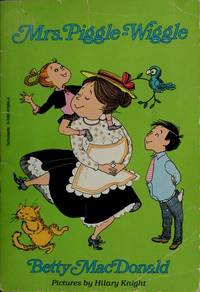
Mrs. Piggle-Wiggle
by Betty MacDonald

Mrs. Piggle-Wiggle was one of my early favorites. The titular character lives in a house built 100% upside-down, and is extremely knowledgeable about children despite having none of her own. All of the parents call her to help them with their poorly behaved kids, and Mrs. Piggle-Wiggle happily obliges. Each chapter is a separate child with a separate “cure” which makes this book great for bedtime reading-as each problem gets resolved at the end of the chapter. One of my favorite cures is the “Won’t Take a Bath Cure”, where Mrs. Piggle-Wiggle instructs the parents to let the little girl get as dirty as she wants, and then secretly plant radish seeds into the dirt while she sleeps. We can all guess what happens next.

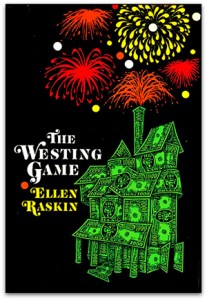
The Westing Game
by Ellen Raskin

Winner of the 1979 Newbery Medal, The Westing Game was my first real introduction to mystery books. I mean, I had read Nancy Drew, but I wasn’t invested in solving the case the same way. I really love how all the clues are laid out for you if you pay enough attention. I love that Raskin shows a wide range of ages and races, with the protagonist being a tomboyish girl named Turtle. Some people have put this book in the ‘didn’t age well’ pile, but I firmly disagree. The characters do have prejudices, and do make assumptions of others, but that’s just it. It’s the characters making the assumptions not the author. And throughout the short read, these characters learn to overcome their prejudices, learn from their mistakes, and become better people.

When Stars are Scattered
by Victoria Jamieson and Omar Mohamed

Moving away from books published well before I was born, When Stars are Scattered is a semi-autobiographical fictionalization of Omar Mohamed and his brother Hassan’s time in a Kenyan Refugee Camp. Published in 2020, it’s also a graphic novel, which makes a topic that could easily be depressing and overwhelming much more palatable for young readers. While this title is much longer than the previous ones, its format makes up for the size. With beautiful illustrations, and an even more beautiful message, When Stars are Scattered will pull at the heartstrings of all who read it.

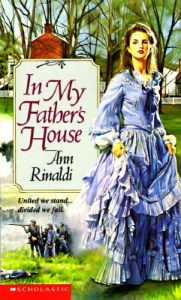
In My Father’s House
by Ann Rinaldi

While only mentioned one time on this list, Ann Rinaldi was, hands down, my favorite author during my middle grade years. A historical fiction writer whose main characters were always young women, her stories spoke to the budding historian in me to learn more about American history. In My Father’s House follows Oscie Mason through the entire Civil War. Oscie is a proud southern girl who knows little about the politics that are about to change her life. A beautiful coming of age story, I will always have a copy of this title on my bookshelf.