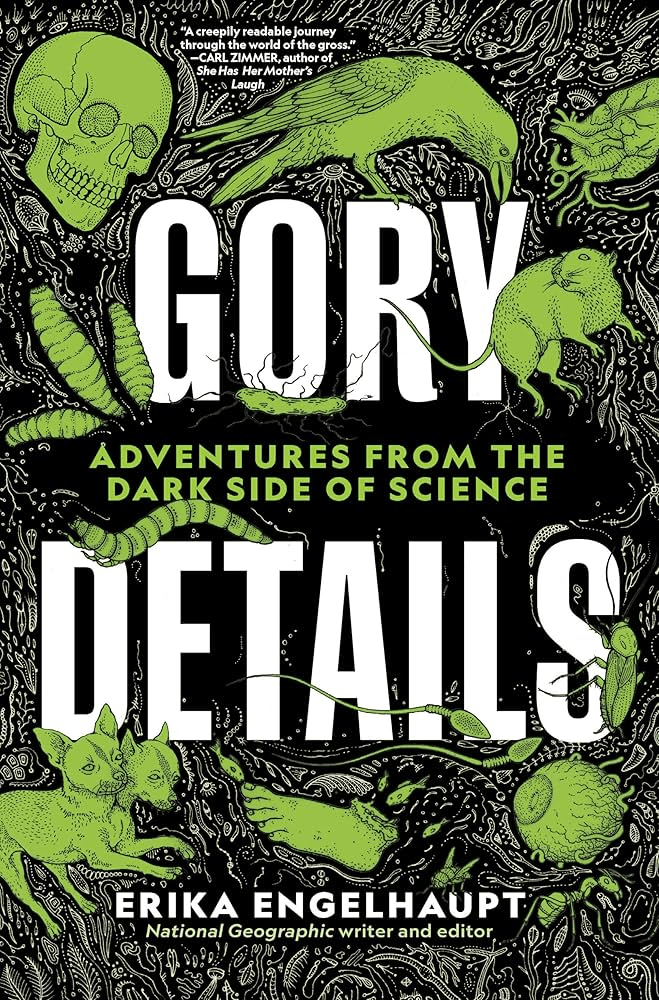
Gory Details: Adventures from the Dark Side of Science

By Erika Engelhaupt

There’s nothing abnormal about being a little abnormal.

Summary

Gory Details is a collection of short, blog-style chapters by the author of the National Geographic blog of the same title. Engelhaupt says in the introduction to this book that some of these chapters are new, and others are expanded versions of posts that can already be found on the blog. Topics include human anatomy, bugs and animals, human psychology, and more.

My Thoughts

Plot

I am intentionally leaving this section blank because this was a work of non-fiction, and on top of that, the format of this book is not conducive to describing an overarching plotline.

Format

This book almost felt like I was reading a series of vignettes-each it’s own story, but attempting to fit into a larger picture. In reality, it was literally a collection of blog posts. Going in, I did not expect to like this format, and coming out, my mind had not changed. I mean, I am writing a blog post, so obviously I am not against the format in and of itself, but I feel there is a distinct difference between reading a blog online for the articles that you are interested in, or want to learn more about, and an entire book in this style.

Blog posts are not supposed to be all encompassing, and there is an expectation that not everything will be explained fully-but in a book setting, I do have that expectation, and when I have questions that are ultimately left unanswered due to the format of the book, I leave disappointed.

That being said-I don’t want you to not pick up this book because I didn’t like the format. For most people, this style of book is a great, high-level introduction to a variety of topics that are tangentially related. And because each section is self contained, it is fairly easy to pick up and put down with ease. That just did not work for the setting that I was reading this book in.

Writing

Erika has been writing the Gory Details blog on Science News and then National Geographic for a number of years. In that time, she has perfected the blog style, writing in an accessible and easily digestible format. Her writing is informative but also engaging, making the science not only understandable but interesting. I would like to note that Engelhaupt is most definitely a writer, not a scientist-so if you are expecting excessive data and detailed citations, you will not find them here. However, if you are looking for an introduction to some of the more gory sides of science and psychology, this could be a good place to start.

Engelhaupts’ writing style is very conversational. You can almost feel like you’re sitting across from her at a bar and chatting over IPA’s and tapas. But then, the conversation just kind of ends, leaving you wanting more. However, unlike meeting in person, you can’t just start up the conversation where you left off at another time. You’ve simply moved on-almost like you’re Lucy meeting Adam Sandler again in 50 First Dates.

Final Thoughts

Looking at other reviews, most people seem to enjoy this book; finding it engaging and digestible. However, for the setting that I was reading this in (book club), it did not work for me. That being said-I can’t help but wonder if the reason that I disliked this book is because it was the third book we read this year instead of the first. I think that I probably would have enjoyed this much more if I hadn’t already read two other long form nonfiction titles. If we had started with this, almost in preparation for the rest of the year, I probably would have liked it better.

However, that isn’t what happened, and therefore, I can only rate based on how I felt reading it.

2.5 stars.
Rating: 2 out of 5.

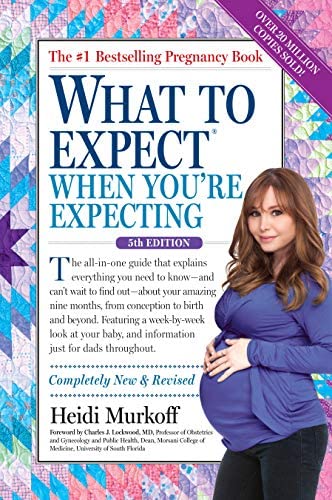
What To Expect When You’re Expecting

By Heidi Murkoff

This is one of those odd times that I review a non-fiction title. And to be honest, this is not the typical non-fiction book, so it will also probably not be a typical review. I’m not going to go through chapter by chapter or section by section. But I digress…

What To Expect When You’re Expecting was first published in 1984 by Heidi Murkoff, Arlene Eisenberg, and Sandee Hathaway. It is now in its fifth edition. The title is touted to be the “bible of American pregnancy” by the New York Times and has topped the paperback bestseller list on multiple occasions. What to Expect can now boast a website, mobile app, and fictionalized feature film. Not bad for a pregnancy guide.

When I found out I was pregnant, this is literally the first thing I purchased. I had every intention of reading this book cover to cover, absorbing every iota of knowledge thrown at me. I’m sure some soon-to-be mothers are able to tackle this task, but I was not. This book was BIG and the print was small, and there were columns, and sections that referenced other sections, and to be honest, I got very overwhelmed very quickly. This book might be a great guide, but for me, it was a useful reference book rather than an informational non-fiction designed to be read cover to cover.

My plan was to be a chapter ahead (reading month 3 while in month 2). But I found myself regularly skimming through to see if the aches and pains I was feeling were normal pregnancy changes or something else. It didn’t help that I needed to stop my ADHD medication, which made focusing on the sheer amount of information substantially more difficult. It also didn’t help that the entire book was in black and white, and most of it was text. Because there were no colors or images to break things up, staring at page after page was tiring.

But was it helpful? I guess this is the important question right? Well, I hate to burst your bubble, but no. To me, this book was more overwhelming than it was helpful. That being said, I’m still glad I purchased it. I do appreciate that it was written as a single book because I think multiple books would become cost prohibitive, but I also feel like purchasing it by trimester might have been more manageable for me-especially since my doctor didn’t even see me until after I was 8 weeks pregnant and the first trimester was essentially over.

The information was semi-useful most of the time, but Murkoff is not an OB/GYN, she’s not a Labor & Delivery Nurse, and she’s not even a medical professional of any kind. She’s just an author. So I felt like a lot of the book was anecdotal, and while I’m sure there was medical science behind the book, there were too many stories for me. I also am concerned that the book did recommend some alternative medical practices like acupuncture and reflexology. There is no scientific basis for either of these practices and encouraging them alongside standard medical practices can be confusing to many people.

One thing that I think we also need to be careful of is the history of this book. It has been around for a LONG time and has become a classic in its own right. However, it is also full of medical information which can go out of date. Buying used copies of this book, or taking hand-me-downs of anything other than the most recent edition could be problematic. This is especially true as things have changed drastically in regard to obstetrics in the past 20 years. Also, it is important to remember that this book should never replace the care of a board-certified OB/GYN or Registered Nurse Midwife. It is a good supplement to help understand your pregnancy but is by no means a replacement.

All in all, I’m glad I purchased this book because it gave me peace of mind to have the resource available to me whenever I wanted it. Looking back though, I probably would have purchased a kindle edition because it takes up less space and is more easily searchable. I agree that it is the most well-known pregnancy book in the United States and for good reason. But I also found the book very overwhelming at times and when you’re already pregnant, being more overwhelmed is probably not the best of situations.

Rating: 3 out of 5.