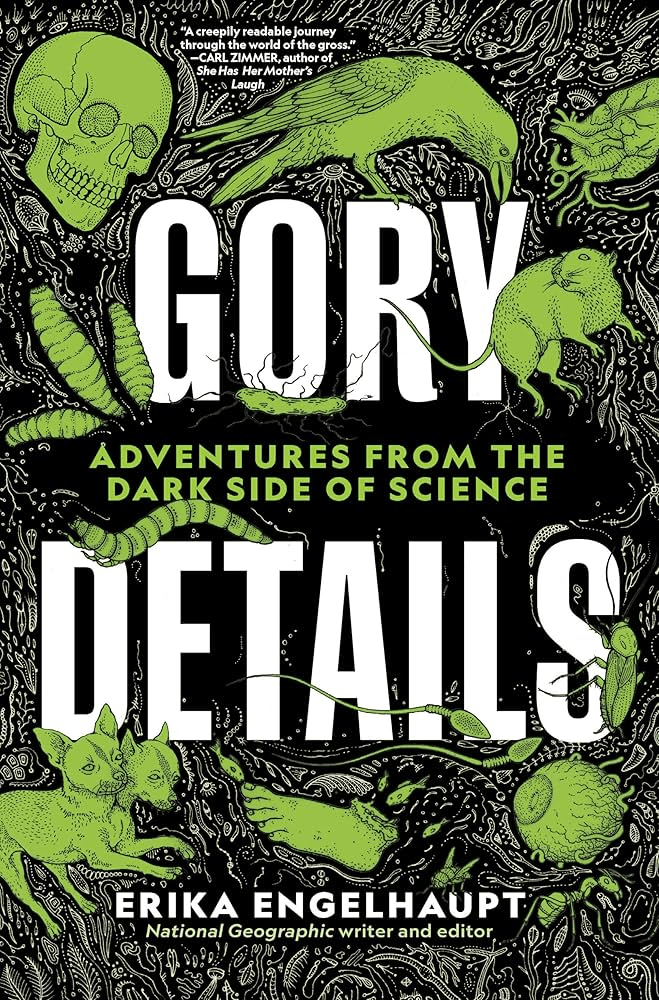
Gory Details: Adventures from the Dark Side of Science

By Erika Engelhaupt

There’s nothing abnormal about being a little abnormal.

Summary

Gory Details is a collection of short, blog-style chapters by the author of the National Geographic blog of the same title. Engelhaupt says in the introduction to this book that some of these chapters are new, and others are expanded versions of posts that can already be found on the blog. Topics include human anatomy, bugs and animals, human psychology, and more.

My Thoughts

Plot

I am intentionally leaving this section blank because this was a work of non-fiction, and on top of that, the format of this book is not conducive to describing an overarching plotline.

Format

This book almost felt like I was reading a series of vignettes-each it’s own story, but attempting to fit into a larger picture. In reality, it was literally a collection of blog posts. Going in, I did not expect to like this format, and coming out, my mind had not changed. I mean, I am writing a blog post, so obviously I am not against the format in and of itself, but I feel there is a distinct difference between reading a blog online for the articles that you are interested in, or want to learn more about, and an entire book in this style.

Blog posts are not supposed to be all encompassing, and there is an expectation that not everything will be explained fully-but in a book setting, I do have that expectation, and when I have questions that are ultimately left unanswered due to the format of the book, I leave disappointed.

That being said-I don’t want you to not pick up this book because I didn’t like the format. For most people, this style of book is a great, high-level introduction to a variety of topics that are tangentially related. And because each section is self contained, it is fairly easy to pick up and put down with ease. That just did not work for the setting that I was reading this book in.

Writing

Erika has been writing the Gory Details blog on Science News and then National Geographic for a number of years. In that time, she has perfected the blog style, writing in an accessible and easily digestible format. Her writing is informative but also engaging, making the science not only understandable but interesting. I would like to note that Engelhaupt is most definitely a writer, not a scientist-so if you are expecting excessive data and detailed citations, you will not find them here. However, if you are looking for an introduction to some of the more gory sides of science and psychology, this could be a good place to start.

Engelhaupts’ writing style is very conversational. You can almost feel like you’re sitting across from her at a bar and chatting over IPA’s and tapas. But then, the conversation just kind of ends, leaving you wanting more. However, unlike meeting in person, you can’t just start up the conversation where you left off at another time. You’ve simply moved on-almost like you’re Lucy meeting Adam Sandler again in 50 First Dates.

Final Thoughts

Looking at other reviews, most people seem to enjoy this book; finding it engaging and digestible. However, for the setting that I was reading this in (book club), it did not work for me. That being said-I can’t help but wonder if the reason that I disliked this book is because it was the third book we read this year instead of the first. I think that I probably would have enjoyed this much more if I hadn’t already read two other long form nonfiction titles. If we had started with this, almost in preparation for the rest of the year, I probably would have liked it better.

However, that isn’t what happened, and therefore, I can only rate based on how I felt reading it.

2.5 stars.

Rating: 2 out of 5.

To be or not to be…a reader of Shakespeare

Did Shakespeare write Shakespeare? To be honest, I don’t particularly care. That’s not what this post is about. Rather, this post is about being a reader of the plays and poems attributed to the man.

English, as a subject, was not readily taught in schools at the beginning of the American educational system. In higher education, men were taught the classic languages-greek and latin mostly. The expectation was that these students would be able to memorize large amounts of information, and would one day be fit for public office. Until the 1800’s, Shakespeare was considered appropriate for pleasure reading and the theater, but not for study. For many reasons, over time, this mentality shifted.

My first introduction to Shakespeare came in 1994. I was three years old. Given, I didn’t know it was Shakespeare until I was much older. But for those of you who say that The Lion King doesn’t count as Shakespeare (it totally does), I read my first abridged play in 8th grade and my first non-abridged my freshman year of High School. Can I just tell you, I absolutely hated it. Like LOATHED Shakespeare. He used words that I didn’t understand, and iambic pentameter was confusing. I couldn’t understand why people thought he was this amazing playwright.

I held onto this belief until my first year of college. Between my first and second year I participated in a short-term study abroad in England. I wasn’t planning on going to England, I wanted to learn about World War II in Prague, Czechia. But since most people weren’t history geeks like me, Prague got canceled and I decided I wanted to visit England regardless of the class that was being taught. So that’s how I got roped into watching 11 plays in 13 days.

It was in these 11 plays that my opinion of Shakespeare drastically changed. Before we left for England, we had to read 4 plays-As You Like It, The Tempest, Much Ado About Nothing, and Winters Tale. I diligently read all 4, attempting to figure out the plot while muddling my way through college level analysis. When I tell you I failed miserably, that is an understatement.

But then I got to London and everything changed…

OK, not really. There’s way more to it than that.

I am going to use one play as a perfect example of this-As You Like It. Basic plot: two girls run away into the forest for reasons, one dressed as a man. They meet the love interest of the one dressed as a man, but he doesn’t recognize her. Shenanigans ensue. Girl loses her disguise and they fall in love. The End.

The first time I read this play, I hated it with a passion. I couldn’t get passed the idea that Orlando didn’t recognize Rosalind. To me, Orlando was an idiot, and I couldn’t become invested in the story because of that. Trust me, if you have read it, you will agree with me.

Then, I saw the play before I left for England. Hated it. Then, I saw the play in Stratford-Upon-Avon. Hated it. THEN, I saw the play at the Globe Theater and I fell in love. As You Like It was crass and bawdy. Orlando was sarcastic AF and Rosalind was a strong woman. I couldn’t stop laughing. I didn’t want it to end. THIS is how Shakespeare was meant to be.

Once I had that experience with Shakespeare, there was no turning back. Later on in college, I actually took another Shakespeare class just for ha-has. When I read Shakespeare before, I was afraid of it. I thought it was written for people smarter than me. Now when I read Shakespeare, I look for the jokes. I look for the political commentary. I look for the wordplay. When Shakespeare was written, it was written to be entertainment, not highbrow literature.

So that was a super duper long way of saying Shakespeare is actually fun. But also, Shakespeare was never designed to be read. It was meant to be watched. When taking Shakespeare at school, I found that listening to the audio while reading was actually super helpful. Sites like LibriVox allowed me to hear different speakers for different characters.

But the Ah-Ha moment for me was watching a fantastic documentary which included a bit from Ben Crystal discussing original pronunciation, or “OP”. This sealed the deal for me. I will never be able to look at Shakespeare the same way.

So to answer the larger question…to be or not to be a reader of Shakespeare. I say yes. You should be a reader of Shakespeare. But not because Shakespeare will make you smarter, or because Shakespeare is fancy. But rather, you should read Shakespeare because it is truly entertaining.